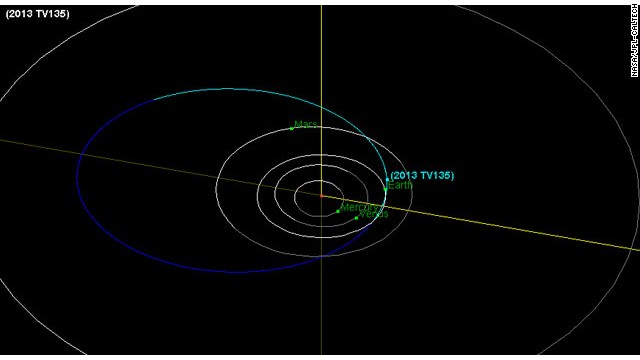
(CNN) -- One of the most dangerous asteroids on record made a near pass by Earth last month.
It made headlines on Thursday, when reports said that there's a chance it could strike the Earth in less than 20 years. Such a collision could unleash a force as powerful as a couple of thousand atomic bombs.
But NASA was quick to calm nerves and point out some very good news. The most dangerous known asteroids don't really pose much of a threat. And there are very few of them.
Also, the chances that this one, which the Ukrainian astronomers who discovered it named 2013 TV135, will collide with Earth are extremely slim.
NASA is 99.998% certain that when it whooshes back around the planet in 2032, it will simply sail past us again.
The odds of it striking our planet currently stand at 1:63,000, and even those odds are fading fast, as scientists find out more about the asteroid.
'This is a relatively new discovery,' said Don Yeomans, manager of NASA's NEO Program. 'With more observations, I fully expect we will be able to significantly reduce, or rule out entirely, any impact probability for the foreseeable future.'
2013 TV135, which was discovered on October 8, looks to soon be joining the ranks of the more than 10,000 known near-Earth objects that pose no foreseeable threat.
But until then, it has the distinction of having a danger rating of 1 out of a possible 10 on the Torino Impact Hazard Scale, the system that rates the danger of impact destruction by asteroids.
That means that it poses 'no unusual level of danger.' There is 'no cause for public attention or concern.'
Almost all other asteroids that scientists have discovered rank a 0 on the scale. There is one other asteroid with a danger rating of 1. And it, too, is no cause for alarm, NASA says.
September's close pass
The close pass 2013 TV135 made on September 16 was not a near miss. At a distance of 4.2 million miles, it flew by about 20 times as far away from Earth as the moon.
That pales by compare to the closest shave the Earth got from an asteroid ever in recorded history.
On February 15 this year, asteroid 2012 DA14 slipped in between the moon and our planet -- just 17,200 miles above Earth's surface.
The asteroid that passed by in September is big -- 1,300 feet across. That's the size of four football fields, but it does not quite make it an Earth crusher.
An asteroid needs to be at least twice as large to advance into that league.
'We believe anything larger than one to two kilometers (about 0.6 to 1.2 miles) could have worldwide effects,' NASA said in a statement.
Near passes daily
Two behemoths in that size range will pass by planet Earth in the next three months at similar distances as 2013 TV135.
In November, an asteroid that NASA believes to be a mile or two wide, will pass at a distance of 12 million miles, and in January, another large one will come as close as 5 million miles from the planet.
NASA says that neither will hit us.
Near asteroid passes are common. They pretty much occur daily, if not two or three times a day, NASA says.
They come, and they go, and they leave the Earth in peace.
In addition, particles from space bombard our planet every minute -- at a rate of 100 tons a day, NASA says.
You eat them; you drink them; you breathe them. Much of you and everything else on Earth contains them.
It is widely believed that an asteroid over six miles wide wiped out dinosaurs along with much of the life on Earth 65 million years ago.
More asteroids like it will come, NASA says.
But they only turn up once every 'few million years.'
That's gives humanity a lot of time to find a way of dealing with it.
 Posted by Unknown on Friday, October 18, 2013 - Rating: 4.5
0 comments "Big asteroid buzzes past Earth and will again in 19 years"
Post a Comment